

Pro forma invoice: payment requested in advance, in its own numbering series
A pro forma invoice is not an invoice: it is a request for payment before you deliver. It is not a tax document, so nothing from it goes to NAV, and it doesn't use your allowance either.
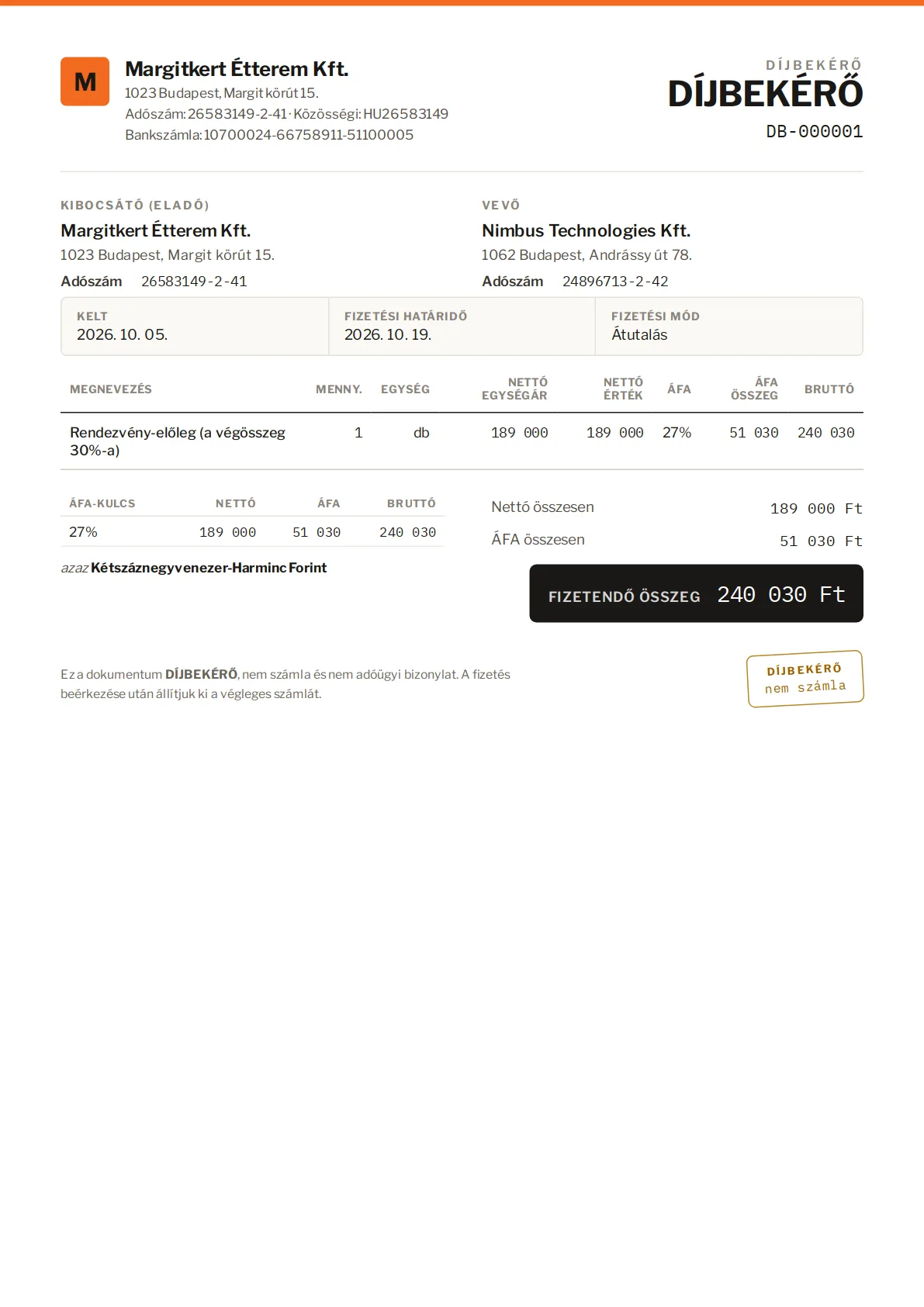
Its own series, its own rules
Pro forma invoices run in a separate numbering series, and the interface marks that they are not tax documents. Your invoice numbering is not affected.
A final invoice after payment
When the payment arrives, the pro forma invoice moves to “Paid”, and if you set it up that way, the program creates the final invoice reported to NAV on the normal issuing path. If you would rather check it yourself, a draft is created instead.
An invoice is due once the money arrives
A pro forma invoice is a payment request, not a document for money received. If the amount arrives before fulfilment, you have to issue an invoice for the advance (VAT Act section 59). The pro forma invoice alone is not enough for that, and the customer cannot deduct VAT on it either. The program creates the document reported to NAV for the payment received.
Payment link on the pro forma invoice
You can add a card payment button to the pro forma invoice you send, and when the payment arrives the document is automatically set to “Paid”. The money goes straight to your own payment account. ⚠️ Today the payment link is available only on forint documents. You can issue a foreign currency pro forma invoice, but we don't add a payment button to it, because the smallest unit differs between currencies, and a wrong multiplier would show up on the customer's card.
Pro forma invoice or advance invoice?
One doesn't replace the other. A pro forma invoice is a request (“pay before I deliver”) and not a tax document. An advance invoice proves that you received the money and how much VAT it contains. It is a tax document and goes to NAV. The usual order: pro forma invoice → payment → advance or final invoice.
Not editable after issue
An issued pro forma invoice is final, and its image never changes again. If you want to change it: Revoke, then “Copy as a new document”, with a new number. What you haven't sent yet you can delete, but what already has money tied to it you can't, because the payment must leave a trace.
In short
- Its own, non-tax numbering series
- Sending by email, with a download link
- Automatic final invoice or draft after payment
- Doesn't use the monthly allowance
Frequently asked questions
Is a pro forma invoice (díjbekérő) the same as a proforma?
Yes, in everyday language both names mean the same: a request for payment before fulfilment. The name “proforma invoice” is misleading, because it is not an invoice. In Hungarian practice díjbekérő is the precise word.
Can the customer deduct VAT based on a pro forma invoice?
No. A pro forma invoice is not a tax document and doesn't pass on VAT. To deduct VAT the customer needs an invoice: for an advance, an advance invoice (VAT Act section 59), otherwise the invoice for the supply.
Do I have to number pro forma invoices?
No law requires gap-free numbering, because it is not a tax document. The program still keeps them in their own continuous series, so your records and references stay unambiguous. Your invoice numbering is not affected.
What happens if the customer doesn't pay in the end?
There are no tax consequences: no tax liability arose from the pro forma invoice, it didn't go to NAV, and it doesn't need cancelling. You can revoke it or simply leave it open.